
Introduction

Today I was sent the Miyoo Mini Flip from LITNXT.com. On behalf of the Handheld Gaming Community I would like to thank LITNXT.com for the review unit. If you like my review of the Miyoo Mini Flip you can purchase one here.

The Miyoo Mini Flip was available for preorder on October 19, 2025 with customers receiving them as early as November 20, 2025. The Miyoo Mini Flip is a follow up to the Miyoo Flip V2. The difference between the Miyoo Flip and the Mini Flip is that the screen is considerably smaller at 2.8″ vs 3.5″ on the Miyoo Flip V2. The device itself is quite a bit smaller as well.
Design and Features


Besides the difference in the size of the screen and body there are a lot of other differences. The most notable difference is the lack of analog sticks. Additionally there is just one micro sd card slot and usb-c port. Also there is no headphone jack. Like modern smartphones you can use a usb-c to 3.5mm headphone jack. Finally there is no HDMI out.
The d-pad and face buttons feel very good and are very responsive.
There are a number of colorways to choose from. You can get the Miyoo Mini Flip in gray, black, white, yellow and pink. LITNXT.com sent me the gray model. I like this color a lot as it reminds me of the Super Nintendo controller color scheme.
Screen Quality

The Miyoo Mini Flip’s screen is small but more crisp than the orgiinal Miyoo Flip. The reason has to do with the fact that not only is it a small screen, but the screen is higher resolution than the original. It doesn’t seem to get quite as bright as the original, but it is still very easy to see indoors.
Build Quality
The biggest improvement in the Miyoo Mini Flip is the build quality. The original Miyoo Flip V2 was built okay, and I certainly never had any problems with the hinge or any other quality control issues. However it just felt less solid. The hinge was super clicky, and felt like it was going to snap every time you hopened and shut it. The Miyoo Mini Flip on the other hand feels completely solid. The hinge is very well made, and smooth.

The only problem I found with the build quality is that there seems to be a slight sound of data noise. If you listen really closely to the Miyoo Mini Flip’s speaker you can hear it. It is not noticeable if you are playing a game. If you have it on in a quiet room you may hear the noise. I feel that this is almost unavoidable given the fact it has a radio in such a small form factor.
Software and UI
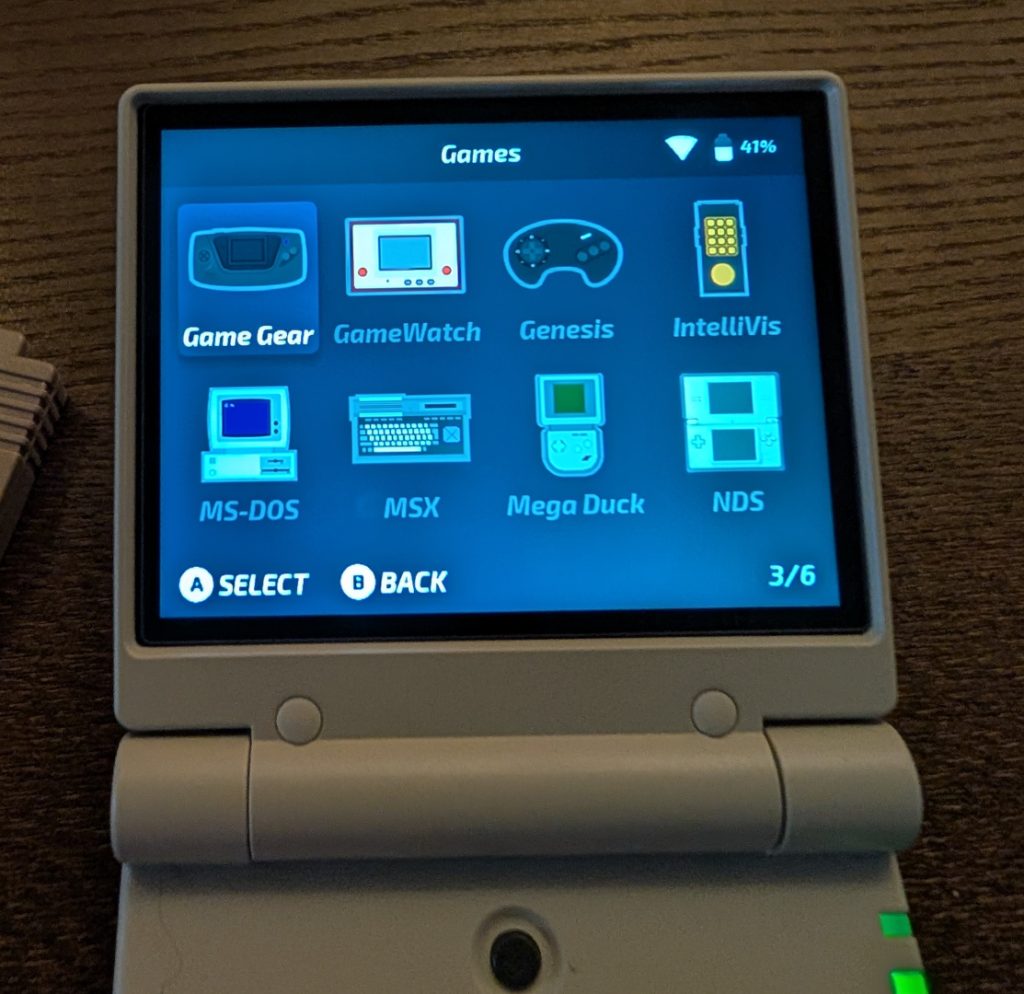
The model of the Miyoo Mini Flip that I received from LITNXT.com comes with a 128GB micro sd card with a branch of Onion OS installed as well as large library of games. The original Miyoo Flip V2 came with a similar set up, but with the Crossmix OS installed. I have found the Onion OS has a bit of a learning curve. However once I got accustomed to the Onion OS it wasn’t a problem. Like CrossMix OS you can choose custom themes and adjust many aspects of the device so that it truly becomes yours.

The only problem I was able to find with the device is that if you put it in standby mode it will continue to run and get fairly warm. I made this mistake when I first booted up the device and put it aside. It seemed to seriously drain the battery when it was in this standby mode. It went from 50% to 6%. I am sure this is a feature that will get ironed out as the branch of Onion OS matures.
Speaking of the battery, I initially had concerns because after my first charge of the battery it seemed to drain really fast. I had used my power bank for the first charge, and I am not sure how well that charged the Miyoo Mini Flip. I plugged it in to a regular phone charging block this morning, and it charged the device from 30% to 100% in under 3 hrs. It seems that after playing Bomberman ’94 for about 20 mins, the battery didn’t drain nearly as fast.
Games and Performance
At the Handheld Gaming Community we only endorse emulation of games that you own, and have rights to play. The only games pictured in this review are games that I own. That said I did try running many different systems, and all worked very well. There was a slight delay in the UI responsiveness, but the games never seemed to skip a beat. The branch of Onion OS comes with systems ranging from the Atari 2600 up to Playstation. It can emulate up to Nintendo DS in the handhelds. It didn’t include any systems that used an analog stick, so I didn’t have the opportunity to test how playing with only a d-pad works in that scenario. I think that the software included was very thoughtfully selected in this way. It only includes systems that it will run well.




Conclusion
I knew it was going to be smaller than the Miyoo Flip V2 before I got my hands on one. However I didn’t realize how much smaller it would be. Despite the small form factor, I found it pretty comfortable to play. The small form factor makes it perfect to play if you are waiting in line at the store. Also it is handy if you find yourself with some extra unexpected time with nothing to do.
The Miyoo Mini Flip has a vastly improved build quality over the Miyoo Flip V2. The most notable improvement is the much smoother hinge, and solid feel. If you like what you have read here you can go to LITNXT.com and buy this device for yourself. The Miyoo Mini Flip costs as low as $75.99 for just the console with no memory card. It will cost $87.00 with a 128gb memory card and the Onion OS + all of the included games. Just remember to use code MMF at checkout.


